Scurt compendiu morfologic de gramatica engleza:
· articolul
o hotarat (the car - masina)
o nehotarat
§ a boy - un baiat
§ a girl - o fata
§ an eskimo - un eschimos
· substantivul
o gen: masculin, feminin: (waiter, waitress - insa deobicei nediferentiat)
o numar: singular, plural: (deobicei pluralul se formeaza cu s)
o caz (declension)
§ nominativ: fata canta - the girl sings, o fata canta - a girl sings
§ genitiv: the girl's voice SAU the voice of the girl - vocea fetei
§ dativ: I tell the girl - Ii spun fetei
§ acuzativ: I hear the girl - O aud pe fata
· adjectivul (descrie un substantiv)
o propriu-zis: green hills - dealuri verzi
o pronominal
§ demonstrativ: this man - acest barbat, that man - acel barbat
§ interogativ/relativ: what book? - care carte?/what I think - ce cred eu
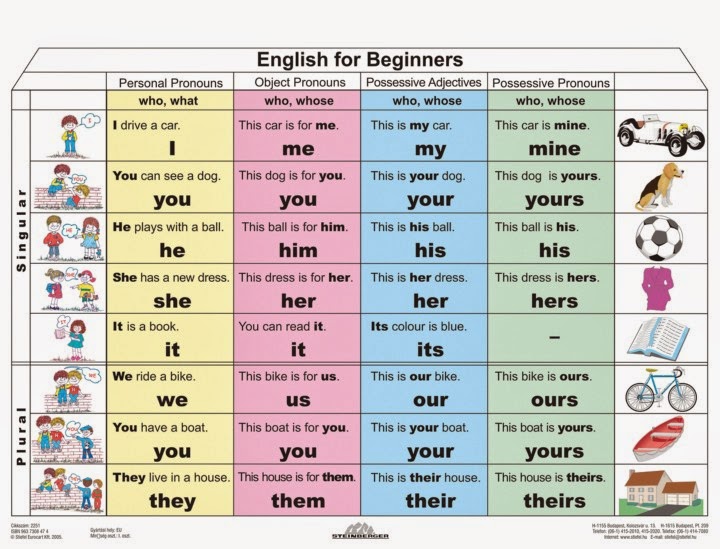
§ posesiv:my book - cartea mea
§ nehotarat(indefinit): some people - niste oameni, unii oameni
o Gradele de comparatie - ca si in romana, adjectivele propriu-zise in engleza au grade de comparatie
§ Comparatia de superioritate
§ Adjective monosilabice si bisilabice terminate in y: smart - smarter - smartest: destept - mai destept - cel mai destept
§ Adjective lungi: intelligent - more intelligent - the most intelligent: destept - mai destept - cel mai destept
§ Comparatia de inferioritate
§ smart - less smart - the least smart: destept - mai putin destept - cel mai putin destept
§ Comparatia de egalitate
§ as smart as - la fel de destept ca
§ Superlativul absolut
§ very smart - foarte destept
· pronumele (inlocuieste un substantiv)
o personal
§ subiectiv(nominativ): you eat - tu mananci
§ obiectiv(dativ, acuzativ)
§ dativ: tell me - spune -mi
§ acuzativ: follow me - urmeaza -ma, urmeaza pe mine; come with me - vinocu mine
o posesiv: it is mine - este al meu
o demonstrativ: that is a koala bear - acela e un urs koala
o interogativ/relativ: what is that - ce e acela, who are you? - cine esti?/the man who came - barbatul care a venit
o indefinit: somebody called - a sunat cineva
o reflexiv: I see myself in the mirror - Ma vad in oglinda.
· numeralul
o cardinal: seven days - 7 zile
o ordinal: the seventh day - a saptea zi
o fractionar: three sevenths of it is done - 3/7 e gata
o colectiv: a dozen eggs - o duzina de oua
o multiplicativ: I paid him back tenfold - L-am platit inzecit
o distributiv: they went in two at a time - au intrat cate doi
o adverbial: I read it a hundred times - L-am citit de o suta de ori.
o nehotarat: many people - multi oameni
· verbul *
o persoana
§ I sing - Eu cant; We sing - Noi cantam
§ You sing - Tu canti; Voi cantati - You sing
§ He, She sings - El, Ea canta; They sing - Ei canta
o numar: singular (I sing, You sing, He sings), plural (We sing, You sing, They sing)
o diateza:(active voice, passive voice)
§ activa (actiunea e facuta de subiect): He scolds the child - El cearta copilul
§ pasiva (actiunea e facuta asupra subiectului): The child is scolded - Copilul este certat
o timp (tenses):
§ Diateza activa (Active Voice)
§ Present Tense: I scold - Eu cert
§ Present Continuous: I am scolding - Eu cert acum (actiune in desfasurare)
§ Present Perfect: I have scolded
§ Present Perfect Continuous: I have been scolding
§ Past Tense: I scolded - Am certat
§ Past Continuous: I was scolding - Eu certam (cand ceva s-a intamplat)
§ Past Perfect: I had scolded - Eu certasem
§ Past Perfect Continuous: I had been scolding
§ Future Tense: I will scold - Eu voi certa (cand se va intampla ceva)
§ Future Continuous: I will be scolding - Eu voi certa (cand se va intampla ceva)
§ Future Perfect: I will have scolded
§ Future Perfect Continuous: I will have been scolding
§ Diateza pasiva (Passive Voice)
§ Present Tense: I am scolded - Eu sunt certat
§ Present Continuous: I am being scolded - Eu sunt certat acum (actiune in desfasurare)
§ Present Perfect: I have been scolded
§ Present Perfect Continuous: Nu se foloseste
§ Past Tense: I was scolded - Am fost certat
§ Past Continuous: I was being scolded - Eu eram certat (cand ceva s-a intamplat)
§ Past Perfect: I had been scolded
§ Past Perfect Continuous: Nu se foloseste
§ Future Tense: I will be scolded - Eu voi fi certat
§ Future Continuous: nu se foloseste
§ Future Perfect: I will have been scolded - Eu voi fi fost certat
§ Future Perfect Continuous: Nu se foloseste
o mod (mood)
§ indicativ (timpurile de mai sus) - actiune reala
§ subjonctiv - actiune ireala, dorita:
§ I wish that this be over - Imi doresc ca aceasta sa se termine - stil oficial
§ I wish that this were over - Imi doresc ca aceasta sa se termine
§ I wish that this had been over - Imi doresc ca aceasta sa se fi terminat
§ conditional - actiune dorita si exprimata printr-o conditie:
§ You should call - Ar trebui sa dai telefon
§ You should have called - Ar fi trebuit sa dai telefon
§ imperativ - actiune poruncita: Go home! - Du-te acasa!
· adverbul (descrie un verb, un adjectiv sau un adverb)
o he is leaving now - el pleaca acum (descrie un verb)
o the amazingly tall building - cladirea extroardinar de inalta (descrie un adjectiv)
o it looks very nice - arata foarte frumos (descrie un adverb)
o Clasificarea adverbelor:
§ de timp: after - dupa, then - atunci
§ de mod: somehow - cumva, slowly - incet (a slow car moves slowly - o masina inceata se misca incet
§ de loc: above - deasupra, faraway - departe
§ de scop: consequently - in consecinta, so that - astfel incat
o prepozitia (leaga doi termeni care nu au aceeasi functie sintactica)
§ I am going to school - ma duc la scoala
§ the book is on the table - Cartea e pe masa
§ out of town - afara din oras
§ smooth as silk - neted ca matasea
o conjunctia (leaga doi termeni care au aceeasi functie sintactica)
§ or - sau; and - si
§ I'll leave when I want to - Plec cand vreau eu.
o interjectia
§ What a pity! - Ce pacat!
§ Wow!; Well, well, well!
*Exista 6 verbe modale: (can, may, must, ought, shall, will). Ele sunt verbe speciale care nu asculta de regulile obisnuite ale verbelor. Ele insotesc cateodata un verb aflat la infinitiv.